Press Release
2.4.2026
TRUCKEE, CA (4 February 2026) A new peer-reviewed paper in Ecological Modelling demonstrates how the Vibrant Planet Platform (VPP) can help land managers accelerate wildfire risk mitigation planning—bridging the gap between Quantitative Wildfire Risk Assessments (QWRA) and the practical, cross-boundary decisions agencies and communities must make to reduce risk at scale.
The publication was co-written by a group of current and former Vibrant Planet and Pyrologix team members. Rather than relying solely on internal validation, the team chose to submit their work to a peer-reviewed scientific journal, where it underwent evaluation by independent reviewers with no affiliation to Vibrant Planet. This decision reflects the company’s commitment to Open Science as a Public Benefit Corporation—a commitment also embodied through its sister nonprofit, the Vibrant Planet Data Commons, a 501(c)(3) which advances Open Science by making cutting-edge data, models, and tools openly accessible for scientific research, education, and public benefit.
The authors describe how to move beyond static risk assessments by using VPP in operational planning that incorporates treatment alternatives, stakeholder priorities, and implementation constraints. Building on the widely used GTR-315 Quantitative Wildfire Risk Assessment framework, the platform translates risk information into decision-ready, implementation-oriented priorities across jurisdictions and landscapes. The platform is designed to enable transparent planning discussions, rapid scenario evaluation, and defensible prioritization aligned with agency decision timelines.
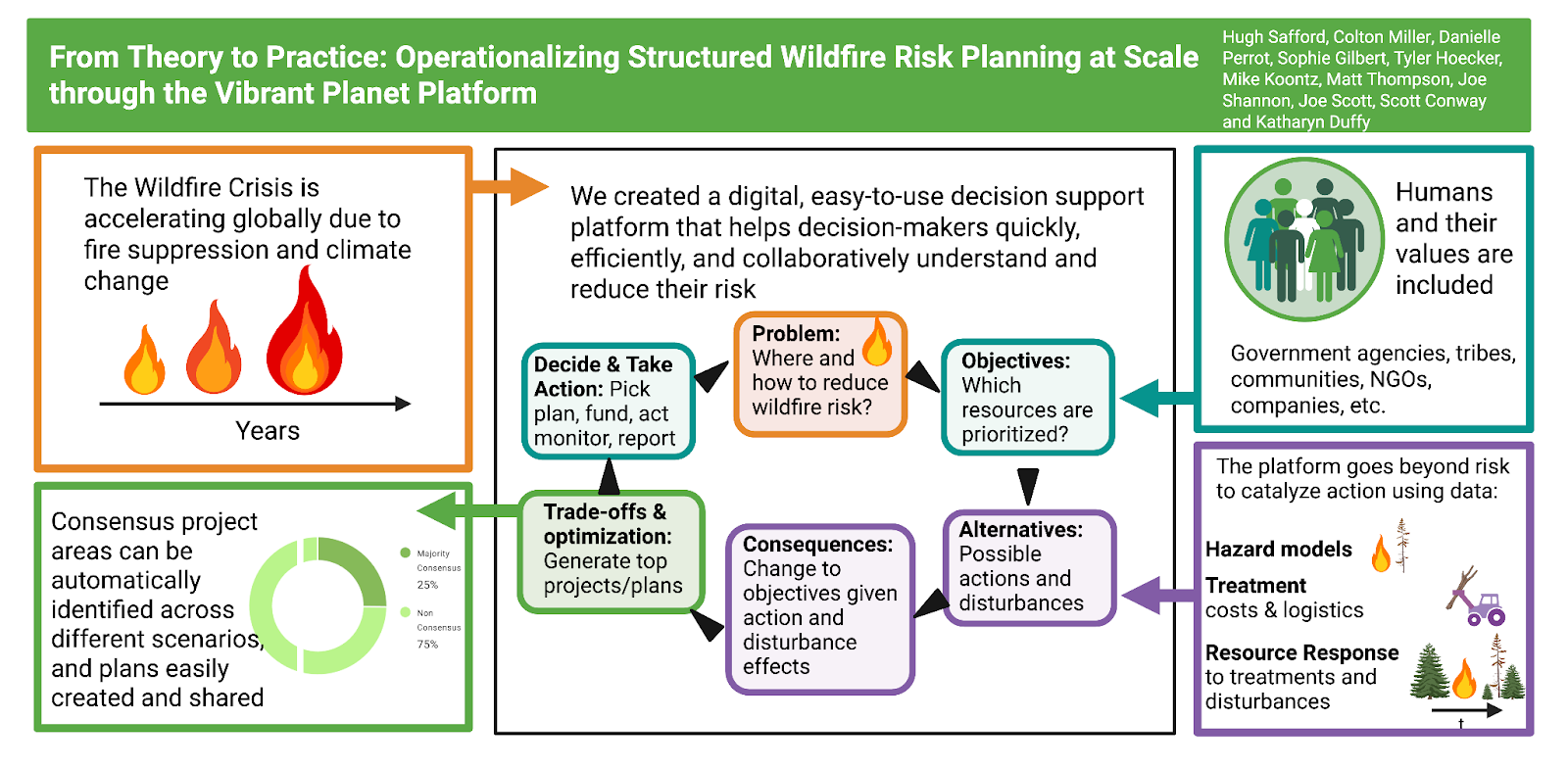
The new publication outlines several ways the Vibrant Planet Platform advances wildfire risk mitigation planning:
From disconnected tools to an integrated planning workflow
From static maps to transparent, scenario-based decisions
From expert-only modeling to broader decision access
From siloed local assessments to collaborative integrated landscape planning
From outdated data sources to dynamic updates of forest structure and risk
From relative change in value to tangible outcome focused metrics
The authors emphasize that this informed and collaborative decision support builds on decades of wildfire science and tools developed by researchers, including foundational work by the U.S. Department of Agriculture Forest Service. The goal of the platform is not to replace local expertise or community governance—but to underpin such local knowledge with tools that help people work together faster, using shared information and clearer choices.
Wildfire risk mitigation planning is increasingly time-sensitive, cross-boundary, and multi-objective, requiring planning systems that are faster, more transparent, and easier to update as conditions change. The study shows how the VPP can serve as an operational pathway to help agencies and partners keep pace with escalating wildfire risk while supporting defensible prioritization and implementation-ready planning.
Title: A collaborative, cloud-based decision support system for structured wildfire risk mitigation planning
Journal: Ecological Modelling
DOI: 10.1016/j.ecolmodel.2025.111464
Scott Conway | Chief Resilience Officer | Vibrant Planet | scott@vibrantplanet.net
Vibrant Planet is the leading wildfire risk management platform, offering state-of-the-art wildfire and ecological analytics and applications that support local, state, and federal agencies, and utilities in prioritizing and measuring the outcomes of specific actions to mitigate risk and build resilience.
We leverage next-generation technology and published, peer-reviewed science to help customers protect communities, manage natural resources, and adapt to rapidly increasing wildfire risk.
Our community and land management technology is deployed across 177M acres in 12 states in the US, spanning land management, fire districts, counties, and tribal lands, and we serve 11 utilities with risk mitigation and PSPS prioritization.